![Omr_reviews_Logo_Black_Rgb_2000px_w_72ppi (2)-3.png]](https://hi.omr.com/hs-fs/hubfs/Omr_reviews_Logo_Black_Rgb_2000px_w_72ppi%20(2)-3.png?height=40&name=Omr_reviews_Logo_Black_Rgb_2000px_w_72ppi%20(2)-3.png)
Every year, OMR Reviews recognizes the 100 tools that received the most and best reviews in the previous year. You can find your current standing in the OMR Manager.
In this article, you’ll find the following content 👇
-
Best practicesBest practices
What the Top 100 ranking shows in OMR Manager
The Top 100 Ranking is a separate view for each tool in OMR Manager. You can find it in the left-hand navigation under “Software & Tools” for your product, under the menu item “Top 100 Ranking.”
There, you’ll see three things at a glance: your current ranking, the rankings of all other tools, and actions you can take to improve your position. The ranking is a snapshot and changes constantly as you and other tools continue to collect reviews. The view updates several times a day.
Important to note: It’s not just the number of reviews you collect that counts, but also how well you’re rated. A tool with fewer reviews can rank higher than yours if its average star rating is higher. Both metrics are factored into the OMR Score, which determines your ranking.
Which Reviews count towards the ranking
For a given year’s ranking, all published reviews submitted during the preceding calendar year – that is, from January 1 through December 31– count.
Four rules determine what is included in the ranking:
-
The submission date is what counts, not the publication date. What matters is the time the review was submitted.
-
Updated reviews count the same way. If an author revises an old review during the current year, it is included in the ranking as of that date.
-
Rejected reviews do not count. Reviews that fail the quality check are not included in either the ranking or your score.
For year-end planning, it’s important to distinguish between submission and publication. Every review goes through our quality check after it’s submitted, and this process can extend into the new year. A review submitted on December 31 that isn’t published until January still counts toward the ranking for the year in which it was submitted. So you don’t have to worry about losing reviews from the last few days of December.
The fact that updated reviews count just as much as new ones is the point that most businesses overlook. If you already have many reviews from previous years, updating those reviews is often a faster way to move forward than gaining completely new customer testimonials.
Your ranking on the Dashboard
The “Top 100 Ranking” tab is located right on the OMR Manager dashboard, with one row per tool.
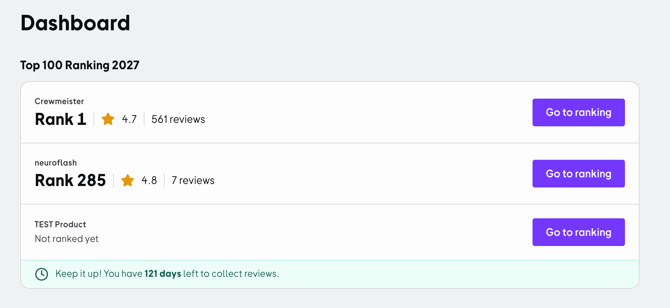
For each row, you’ll see:
-
The tool name and, below it, its current ranking.
-
The average star rating and the number of valid reviews.
-
The “Go to Ranking” button, which takes you directly to the full view for this tool.
Tools that don’t yet have any valid reviews for the current year are marked as “Not yet ranked” on the map.
At the bottom of the map, there’s a countdown that tells you how many days you have left to collect reviews this year. It counts down to December 31 because the collection period ends with the calendar year.
The ranking view in detail
Go to Software & Tools → your product → Top 100 Ranking to access the full view.
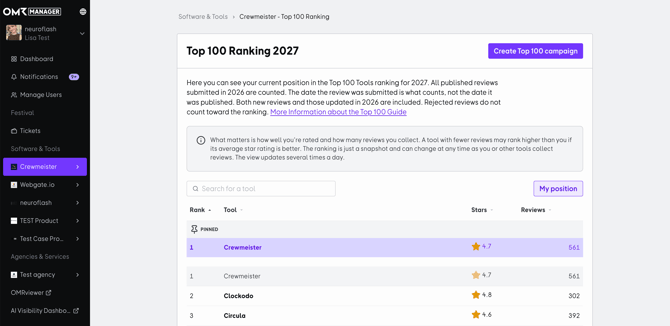
The Table
The table lists all ranked tools in four columns:
-
Rank → the current position in the ranking
-
Tool → the name of the tool
-
Stars → the average star rating based on eligible reviews
-
Number of Reviews → how many reviews count toward the current ranking
Your own tool is pinned at the top as “FIXED” and remains visible no matter which page of the table you navigate to. Use the pagination at the bottom to scroll through the list, and use “Rows per Page” to change how many tools are displayed at once.
The list includes all ranked tools, not just the top 100. This means you’ll see a specific ranking even if you’re currently far from the top 100. That’s exactly what makes this view useful for tracking your progress.
Search and “My Position”
Use the “Search for Tool” field to jump directly to a specific tool. This is the fastest way to check the tools you’re comparing yourself to.
The note about outdated Reviews
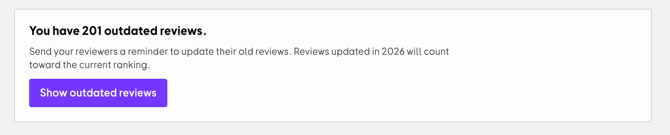
Below the table is a separate card that shows you how many outdated reviews your tool has, along with the “View Outdated Reviews” button. Clicking it takes you directly to the section where you can invite the reviewers to update their reviews.The “My Position” button takes you back to the page in the table where your own tool is listed. This way, you can see not only your rank but also the tools directly above and below you, including their star ratings and number of reviews. This gives you a reliable answer to the question of how many reviews separate you from the next tier.
How to create a Top 100 Campaign
Click the “Create Top 100 Campaign” button in the upper-right corner of the ranking view to start a review campaign that's already tailored to the ranking. The form is the same as for any other review campaign, except that some fields are pre-filled.
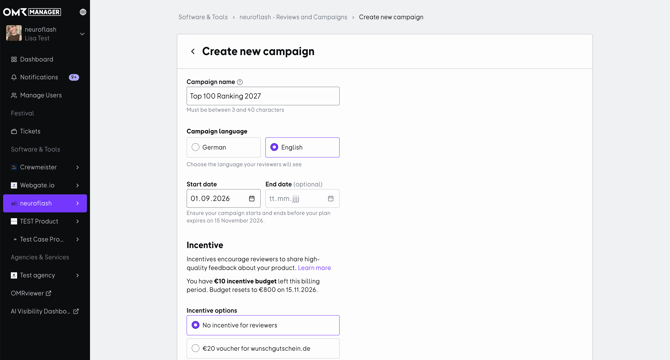
Step 1: Review the campaign name
The name is pre-filled with “Top 100 Ranking [Year]” and must be between 3 and 40 characters long. The name is visible only internally. If you’re collecting reviews through multiple channels at the same time, include the channel in the name so you can later determine which channel generated the reviews
Step 2: Set the language and duration
Under “Campaign Language,” select whether reviewers will see the form in German or English. The start date is set to the current day; the end date is optional.
Be aware of two deadlines that are not the same: Your campaign must fall within your contract period; the note below the date field specifies the date. Additionally, for the ranking, the review must be submitted by December 31.
Step 3: Choose an Incentive
You have three options: no incentive, a €20 gift card for wunschgutschein.de, or a gift card for amazon.de worth between €10 and €100. Above the selection field, you can see how much incentive budget you still have available during your current contract period and when it will be reset.
Use incentives when you’re specifically targeting individual customers, such as in a personal email or during a customer appointment. They aren’t effective on social media or in paid ads because you can’t control who clicks the link there.
Step 4: Customize the invitation text
Under “Personalized Invitation,” enter the text that reviewers will see on the feedback homepage between 10 and 250 characters. A preview appears on the right, showing how the text will appear alongside the standard instructions for logging in, reviewing, and providing feedback. You can return to the original version at any time by clicking “Restore Default Text.”
Use this space to explain the reason for the request, not to describe the product. A sentence that specifies the purpose works better than a general invitation.
Step 5: Create a campaign and share the link
Clicking “Create Campaign” sets up the campaign and provides you with a unique invitation link that you can use in emails, newsletters, in-app notifications, or during customer appointments. All incoming reviews are assigned to this campaign, allowing you to accurately track its success.
Updating outdated Reviews
Reviews older than 12 months do not count toward the current Top 100 ranking. If such a review is updated by the author, it will count in full again as of the new submission date.
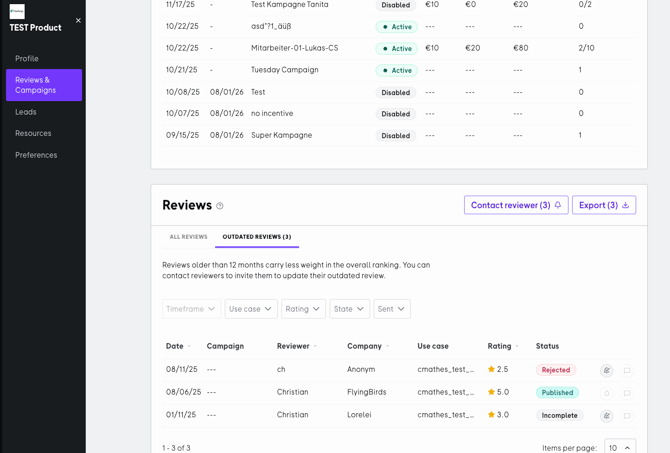
You can find the list under Software & Tools → your product → Reviews & Campaigns in the “Outdated Reviews” tab.
Use the filters for time period, use case, review, status, and sent to narrow down the selection before sending the reminder.
There are two limits you should be aware of when planning: A maximum of three reminders are allowed per review, and there must be at least 45 days between two reminders. An update also requires at least one substantive change to the review.
For most providers with a long history on OMR Reviews, this is the fastest way to improve their score. The connection already exists; the person is familiar with your product and doesn’t have to write a review from scratch – they just need to update an existing one.
Best Practices
Start by addressing outdated reviews
-
Problem: Vendors launch broad new campaigns even though several hundred existing reviews are losing their weight because they’re not being utilized.
-
Approach: First, check the number in the “Outdated Reviews” tab and send reminders to the reviewers before investing your budget in new campaigns. Filter for reviews with a high star rating – that’s where the impact on your score is greatest.
-
Result: Updated reviews count toward the current ranking with full weight, without you having to convince new customers.
Monitor your position rather than your ranking
-
Problem: The raw ranking number alone says little about what needs to be done. A jump from rank 285 to rank 240 could be due to a single review or twenty.
-
Approach: Use “My Position” and look at the listings directly above you. Compare their star ratings and number of reviews with your own to assess whether you’re lacking in quantity or quality.
-
Result: You’ll know whether you need more reviews or should specifically target satisfied customers instead of collecting them blindly.
Launch campaigns early in the year
-
Problem: Many providers don’t start until fall, when the countdown on the dashboard is already short. But reviews require lead time because they’re moderated and customers don’t respond immediately.
-
Approach: Set up the Top 100 campaign at the beginning of the year and let it run continuously, rather than running a one-time promotion right before the end of the year. Distribute the link through recurring touchpoints such as onboarding emails, QBRs, and support signatures.
-
Result: Reviews are spread out over the year, you’re not reliant on individual campaigns, and you can see in real time on the dashboard whether the count is changing.